In my professional life I come across people ruminating on the state of the world - usually with the objective of trying to make some money out of it. These cogitations often emphasise the parallels of the world now, to the world before World War II: with a hitleresque figure on the loose, willing to throw his weight around1.
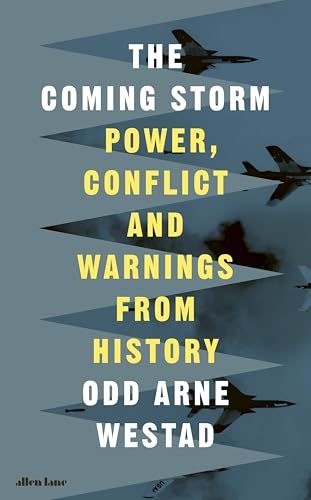
Ode Arne Westad in The Coming Storm emphasises a different parallel for the present day: the world before World War I, in the early 1900s. The problem right now as he sees it is not as simple as 'bad guy on the loose' but a shift to a 'multi-polar world' in which the possibility of a major conflict becomes much more likely - and this possibility (probability) of a serious conflict is grossly underestimated.
So if we are in a multipolar world who are the poles? In order of the amount of space given to them in the book they are:
- China
- United States
- Russia
- India
- Turkey
- Japan
- EU
- Brazil
This compares to the poles of the early twentieth century:
- Britain
- France
- Germany
- Russia
- Austro-Hungary
- Japan
In the early 1900s Arne Westad casts Britain as the declining hegemon (relatively speaking), leading to instability as other countries start jostling for position, with Germany in particular muscling in on the action. In the 2020s it is China which is rising to global prominence while the United States is looking over its shoulder with apprehension.
The superiority of the British nation was taken as a given... this superiority was seen as part of the natural order of things, created by the strength of their economy, their institutions, their empire, and their military, first and foremost the Royal Navy.
Ode Arne Westad, The Coming Storm
If you have a superiority complex, a growing sense of inferiority can be hard to manage.
Peacecraft
One of the key arguments of the book is that peace doesn't happen by accident. It is not the 'default' position, but is something that needs to be actively worked towards. And right now no-one is making much of an effort for peace at all...
Just like in the era before 1914, there is today a deeply held sense that Great Power war is, if not impossible, then highly unlikely. We need to get rid of this complacency.
Ode Arne Westad, The Coming Storm
Worryors
Another key point in the book is that war in general is bad, and that war between great powers is really bad.
As a reminder: millions of people would likely die. Your friends, family and neighbours could die. You might die. The author tells a story of the Great War 100 years ago in which just one battle (The Battle of the Somme) saw over 1 million casualties in five months.
To make the Battle of the Somme stats more human he focuses in on one Alfred Webb, who died in combat. The enormous scale of the battle was such that alongside Alfred Webb there were four other soldiers who died also called Alfred Webb. As an A Webb myself (with a brother who is another A Webb) this resonates. If you didn't die you were scarred for life, possibly physically, probably mentally.2
Great power war is to be avoided.
Flashpoints
With the backstory in place Arne Westad looks at a number of places where great power war might break out now, including Taiwan (US vs China), North Korea (US vs China), the Himalayas (India vs China), the Philippines (US vs China), Ukraine (Russia vs the EU?) and the Middle East (everyone vs everyone).
A China-US war over Taiwan is a real possibility at some point during the next decade... The combination of existing Great Power tensions, alongside the PRC's obvious aggressive intent... makes for an explosive mix...
Ode Arne Westad, The Coming Storm
Does he have a point?
It is clearly right to say now that the world is more unstable now than it was ten years ago, and that this instability will likely increase if other countries - in particular China - feel that they are able to challenge the United States and it is in their interests to do so.
It is also right that we shouldn't be complacent about peace: it doesn't necessarily happen by accident, as I can attest from the often exasperating behaviour between my two boys (aged 7 and 10).
However one difference between the potential great power conflicts of today and a hundred years ago is that the great powers now are much more spaced out around the globe. The capability to damage people from a distance has increased immeasurably since 1914 but surely (and I may be clutching at straws here) the fact that there is no realistic prospect of any one of Russia, the United States and China invading any other one is beneficial? Isolationism is a more realistic strategy now that it was then.
What is the book like to read?
The Coming Storm is short and punchy, with only three chapters and a couple of hundred pages. It is clearly meant to be read by ordinary people, maybe even busy people.
It feels something like a cross between a model undergraduate comparative history essay and a good old fashioned polemic, Thomas-Paine-style.
It is easy to read, systematically set out, and thought provoking.
The best bit
What I appreciated most about this book is that unlike many of the pundits and experts that I come across in my day-to-day life Arne Westad doesn't rely on personalities to describe the world. So rather than ascribing our current problems as the result of narcissistic egomaniacs such as Putin or Trump, he assigns them to longer term structures of power. This is much more satisfying to me and helps to explain why someone like Trump can be appealing in the first place (to United Statesians).
Conclusion
If you want to understand the world that we live in today in a historical context (or if you have a history essay deadline coming up on the causes of World War I) this is a great starting point.
Succinct, stimulating and a little scary - recommended reading.
The speaker usually means Putin but occasionally Trump. ↩︎
You sometimes hear the other side of this argument: that lots of soldiers actually quite liked the war because it was exciting and they got to do things they don't normally do such as drive tanks and kill people. In my view this is another point against war: we shouldn't be encouraging this sort of thing. ↩︎
Book details
(back to top)- Title -
The Coming Storm : Power, Conflict and Warnings from History
- Author -
Odd Arne Westad
- Publication date -
March 2026
- Publisher -
Allen Lane
- Pages -
256
- ISBN 13 -
9780241770573
- Amazon UK -
- Amazon US -