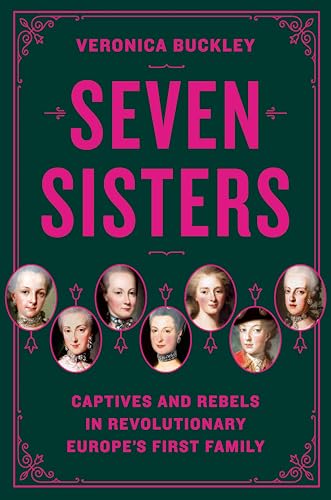
Some of the perks of royalty in mid 18th century Europe included: good food, big houses, chat with Enlightenment celebs, plus everyone else had to say you were awesome. I had always thought that the biggest downside was that you might get your head chopped off, but after reading Seven Sisters: Captives and Rebels in Revolutionary Europe’s First Family by Veronica Buckley I now realise that losing your head was actually quite rare and in reality the biggest drawback of being a royal was: you had to marry another royal.
Because, despite the deference, many royals were not awesome, they were awful. Severely limited interpersonal skills were just the start - and why bother with them when everyone has to agree you are the best anyway? Parental affection or even attention could also be highly variable, or even deliberately cruel.
Married by proxy before first sight
For example when Queen Carolina of the Kingdom of Naples (titular sister number 6) organised a double match between her son and daughter and two of their Spanish Bourbon cousins, she was pleased with her diplomatic achievements. But when she met the two young Spaniards for the first time on their arrival at Naples she was horrified to discover that they were both physically and mentally stunted. The little girl aged 13 was described as “a tiny person, as fat as a ball”. As Buckley says:
She spoke only Spanish, and that very little, responding to all approaches with a silly giggle. [Queen] Carolina thought at first she must be deaf, then realised that she was simply the victim of an appallingly bad education: She did not even know there were countries in the world besides Spain and Naples.
Seven Sisters, Veronica Buckley
Carolina’s daughter’s assessment of the Spanish prince and princess was equally despondent:
I thought we were choosing two divinities, and instead we’ve got two cabbage sprouts... I am desperate.
Maria Antonia, in Seven Sisters by Veronica Buckley
Nightmare romance
Although a vegetable is a let down, it could be even worse. Queen Carolina herself (the mother mentioned above) was married off to Ferdinando IV in 1768. He was an ugly, boorish, single-minded sex addict. Carolina in a despairing letter to her brother the King of Tuscany described how Ferdinando had forced himself upon her even when she was seven months pregnant, and despite his member being covered with syphilitic ulcers, a disease which he had contracted from his mistress. He refused the mercury treatment for syphilis because he found it too painful, but equally refused to stop sleeping with Carolina. She had 18 children over a twenty year period, 11 of which died in infancy. Two of her babies had shown signs of the disease.
A dirty fella
Dealing with a sex maniac who was above the law was horrific. Carolina’s sister, the fun loving Amalia, had to manage the opposite problem. Her newly wed husband Don Ferdinando I, Duke of Parma, was unable to perform in bed. Erections were incredibly painful. This was a matter of public concern because a royal marriage without children was dynastically useless. After a few months without consummation a doctor was called. Despite Don Ferdinando’s fears the diagnosis was straightforward: his penis was simply encrusted with filth.
A deeply religious man, it had been impressed upon him from an early age that he must not touch himself down there. Taking this seriously and literally he had never washed his private parts. Apparently with a bit of soap and water the issue was resolved. This story sounds incredible (how did he go to the toilet if he didn’t touch himself?) but in the context of the monarchs we are introduced to in the book it is entirely believable.
Unhappily married
So when we hear the well known quote:
Others make war; you, happy Austria, marry
Attributed to King Matthias Corvinus of Hungary (1458-90)
It makes you appreciate that the happiness of the Austrians was frequently paid for by the misery of the royal daughters. This is a long way from being a Disney princess.
Who’s who?
So who were the seven sisters mentioned in the title? They were the seven daughters of Maria Theresia, ruler of the Habsburg Empire from 1740 to 1780 - those who survived to adulthood. The most famous of the daughters was the youngest: Maria Antonia, better known by her French name Marie Antoinette and destined to be guillotined in the French Revolution. But another three also became rulers, including Carolina and Amalia mentioned above with the terrible husbands. Two other daughters had roles within the borders of the empire and one died of smallpox just before her marriage ceremony (age 12).
The Habsburg Empire at this time was massive, much larger than the lands of Austria and Hungary are today. It stretched from the Ottoman lands of Greece and the Balkans in the south east, towards Italy and the German states in the west and north, with bits and pieces of other territories here and there.
The ruler of the Habsberg Empire was also, by tradition, the Holy Roman Emperor, appointed by the eight Electors from the German states, and so nominally in charge of another vast area.
The spring of hope, and the winter of despair
Along with the French and Spanish royal families the Austrian Habsburgs were the uber monarchs in a period that saw the beginning of the end of monarchy as an institution with the coming French Revolution in 1788. The Habsburg family and the daughters in particular were at the centre of pretty much all the momentous events of the age.
It was really interesting to me to be reminded how different the map of Europe was at this time, on the eve of the French Revolution. Italy was split up into a number of small states, Germany was just a big mess. Even France had its quirks, such as the Comtat Venaissin, a weird papal state in the area around Avignon.
The map below shows you more or less what it looked like - if you click on or hover a territory it will show the name. The yellow dots indicate the main destination of each of the seven daughters, starting at the big dot which is their place of birth: Vienna. The disclaimer is that I took this map from Wikipedia then got an AI agent to both simplify it - here is the fantastic original map - and to name all the territories, so a few errors may have crept in.1
Map of Europe in 1780, showing the Habsburg Empire in yellow, and the destinations of the Seven Sisters, from their birthplace in Vienna
Marriage mapping
One of the reasons that this book works so well is that it brings this (for us) unusual political landscape to life. Each of the daughters was a piece on a chess board, and following their sometimes tragic progress as they were pushed here and there in various marriage alliances is a really effective way to get a feel for the political currents and undercurrents of the time.
It also works very well as a multi-biography. The three main characters that emerged out of the book were Maria Theresa (the matriarch), Queen Carolina (sister 6), and Marie Antoinette (sister 7). Each of them was a dominant figure in their respective kingdoms, with variable degrees of success.2 None of them are painted as particularly likable characters: they were warped by the demands of monarchy along with their male counterparts, but they all come alive as real people.
Style guide
Telling a story about a large royal family that is connected to every other royal family in Europe in one of the most eventful 50 years in European history is a huge challenge. Buckley’s approach is to split the whole period up into smaller chunks of time, sometimes just a single year, making each time chunk a chapter. The chapter will then range from place to place depending on where the sisters happen to be at the time.
This is effective but does mean I lost the thread of the narrative every now and again - forgetting which Ferdinando we were talking about, the rapist or the filthy one? and what was sister 1 (or was it 2?) doing in Innsbruck? and who was that in a nunnery? If you are going to talk about everyone though it is probably the only way to do it.
I also felt that because so much material needed to be covered the style can feel rather staccato at times, like a diary when you get a bit fed up of writing down everything you did that day.
Overall though it works and hangs together as a single narrative which is no small achievement.
What I most liked about the book
What I thought was brilliant about this book was the alternative perspectives it gave me: the perspective of Europe with Vienna at the centre of the world; the perspective of banishment by marriage to a foreign court; the perspective of an inescapable requirement of obedience to dreadful husbands and pitiless kings.3
Conclusion
A fascinating story of a royal family that provides a window on late 18th century Europe but a window overlooking a less familiar side of the garden.
Although it takes a bit of perseverance and concentration I would recommend this book to anyone with an interest in this period - or who thinks Disney princesses are in any way representative of real life.
The reason that the Ottoman Empire is missing a big chunk in the Levant though is more down to the area covered by the original map - we can't blame AI for this! ↩︎
The degrees of success were: Maria Theresia - lots; Queen Carolina - some; Marie Antoinette - very little. ↩︎
The seven sisters also had to obey their Habsberg Emperor brothers and then nephew without question too, who would forbid the sisters they didn’t get on with from coming within 6 miles of Vienna. The first thing that their brother the Emperor Joseph II did when their mother the Empress Maria Theresia died was to banish the sisters from their homes in the capital (those who had not already been sent off to be married). Why? No reason, he just found them a bit annoying. ↩︎
Book details
(back to top)- Title -
Seven Sisters : Captives and Rebels in Revolutionary Europe's First Family
- Author -
Veronica Buckley
- Publication date -
March 2026
- Publisher -
Penguin Group
- Pages -
545
- ISBN 13 -
9780525561903
- Amazon UK -
- Amazon US -