There is a seduction in reading history via poetry. For one thing it is quicker to read a poem than a narrative, so you can rattle through the years very efficiently. With poetry you also feel you are really getting to the essence of a thing: all that prose is boiled down until what you have left is super-saturated with meaning. Perhaps you have reached the truth.
A history of the universe in 100 limericks
It’s a format I have dabbled with myself in “A history of the universe in a 100 limericks”. Covering 100 time periods from the present day to the big bang (or visa versa, it’s up to you). After every 10 poems, the timescale zooms out by x10 years. To give you a flavour here is the limerick covering the period from 20 million years ago to 30 million ago, when the last ape-monkey concestor was thought to have lived:
The ape’s tale should not be forgotten
It begins with a monkey’s bottom:
“My bum feels all wrong
My tail, it has gone!”
And our ancestor ape was begotten.
So far I have written about 30 limericks but the remaining 70 are still on the to-do list. I’m resisting the temptation to get AI to write them for me. The tricky period is from 5 billion years ago to 12 billion years ago where, in the context of the human story, absolutely nothing of interest happened at all. Any publishers reading this looking for the next big hit just let me know.
A history of England in 25 poems
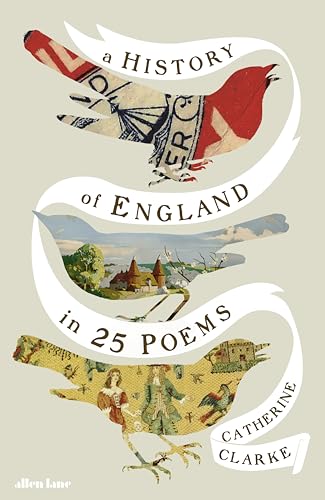
Luckily the human story told through poetry doesn’t rely on me getting my act together because many better guides have put pen to paper already, not least of which is Catherine Clark in A History of England in 25 Poems. While she limits herself to the story of the nation of England from its emergence in the Anglo-Saxon kingdoms up to the modern day she does so with more depth than can be achieved by self-penned limericks, picking poems from 25 different authors.
Each poem is examined for the truths it reveals.
To focus on “Pearl”, the poem from the time of the Black Death: we experience the raw grief of (presumably) a parent mourning their lost child, the beautiful pearl of the title:
Alas! I lost her in a garden,
Through grass to the ground it fell from me.
I languished, pierced with love-longing
For that dearest pearl without a spot
The author struggles to reconcile the promise of heaven and the (his?) earthly feelings of loss:
Though the mercy of Christ gave me comfort,
My wretched spirit was tormented with sorrow.
Clarke takes us through the poem step by step, drawing out the implications of certain word choices, what we can know and what we cannot.
Summer time
As well as personal truth a poem can also tell us something about how people of a time viewed the world, ie the culture.
A good example of this is the poem “Sumer is Icumen in” from around 12601. This is quite a short poem so here is the whole thing:
Sumer is Icumen in - click to see the poem translated into modern English
Summer has come in!
Loudly sing, cuckoo!
The seed grows
and the meadow blossoms
and the wood springs (into leaf) now.
Sing, cuckoo!
~
Ewe bleats after lamb,
Cow lows after calf.
Bullock leaps,
Stag farts,
Sing merrily, cuckoo!
~
Cuckoo, cuckoo,
You sing well, cuckoo,
Don’t ever stop now!
~
Sing cuckoo now; sing cuckoo.
Sing cuckoo; sing cuckoo now.
And for those of you who prefer old English:
Sumer is Icumen in - click to read in the original old English
Sumer is icumen in
Lhude sing cuccu!
Groweþ2 sed
and bloweþ med
and springþ þe wde nu
Sing cuccu!
~
Awe bleteþ after lomb,
lhouþ after calue cu.
Bulluc sterteþ,
bucke uerteþ,
murie sing cuccu!
~
Cuccu cuccu
Wel singes þu cuccu
ne swik þu nauer nu.
~
Sing cuccu nu; sing cuccu.
Sing cuccu; sing cuccu nu.
The interesting thing about this poem is the earthy content (stags farting and whatnot) combined with the context in which it was found - a cherished compendium belonging to the monks of Reading Abbey. Shouldn’t these churchmen have their minds on higher things?
We shouldn’t assume the worst of the monks, says Clarke.
Interspersed with the “here comes summer” stuff there is an alternative set of words that can be sung to the same tune. This time the lyrics are much more like what you would expect from a group of full-time Christians:
Sumer is Icumen in, accompanying latin hymn
Observe, Christian,
such honour!
The heavenly farmer,
because of a flaw in the vine,
not sparing the Son,
exposed him to the destruction of death.
He gives his life to the captives half dead from torment,
and crowns them with himself on the throne of heaven.
You can look up the original manuscript of the poem on wikipedia, and I have shown a picture of the page below.
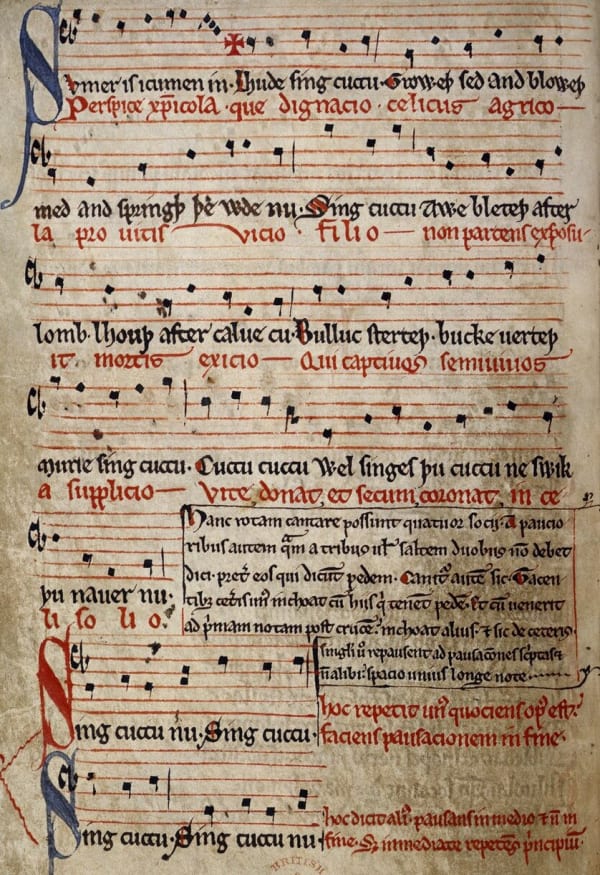
Sumer is Icumen in, British Library Harley Manuscript 978, CC
If you look closely you can see that the black text just under the lines of musical notation is the earthy Sumer is icumin in lyrics, while the red text just underneath that is the Christian hymn. The words of the two songs are closely connected on the page.
The reason that these two contradictory texts - profane and sacred - are set out side by side, Clarke tells us, is that at that time they were not seen as contradictory at all. Illustrated manuscripts with bums and willies lovingly rendered in the margins, or misericords carvings of flatulent men were a recognised (and officially sanctioned) part of medieval church life.
I believe this is because bums - like everything else - were created by God, therefore they can be enjoyed from a religious perspective. Or to put it another way: God is responsible for the spiritual and secular world, so you can laugh at a fart joke in good conscience: see the world in a guff of wind, and heaven in a meadow flower.
Style guide
A history of England in 25 poems is pleasantly easy to read. Each poem has its own chapter and each chapter is short enough to read in 20 minutes or so.
Clarke’s writing is straightforward and she is careful to explain the poems clearly, often going through them line by line.
It does sometimes have the smell of the schoolroom about it: dismembering a poem so thoroughly that it can no longer move of its accord. But this is very much a subjective view: I found the pointing out of the obvious quite helpful on the poems I struggled with, less so when I felt I knew it all already.
Any downsides?
One problem with a book like this is, in my view, that it can over assume authenticity.
We are rightly cautious when someone is writing on behalf of an institution - a newspaper journalist say, or an Anglo Saxon Chronicle scribe. Or when an individual is writing about an event. We take it for granted that they will represent a particular point of view. But as soon as a person starts writing poems about their feelings we readily accept that this is a window to their soul, or even the world.3
This struck me in particular when reading the poem “The Balland Which Anne Askew Made And Sang When She Was in Newgate” by Anne Askew (1546). The reason that she was in Newgate prison was because she had been condemned for heresy (she was a protestant) and was to be burned to death as a punishment. While she was waiting she composed a poem of defiance.
Here is a sample verse:
More enmyes now I have
Than hairs upon my head.
Let them not me deprave
But fight thou in my stead.Anne Askew, in A History of England in 25 Poems
Clarke tells us that this is the first poem we can clearly attribute to a female author.
The trouble is that to me the piece has “hack job” written all over it. I don’t think she wrote the poem because the language just feels like it has been written by a newsheet hack and then attributed to Anne Askew to sell more copies.
I might be right or wrong about this. But if it wasn’t written by Anne Askew, and instead by a hack pretending to be Anne Askew, this sucks all the meaning out of the poem. All the careful analysis of her words is pretty much wasted.
This is an extreme example but to some extent I feel all poets are emotional puppeteers and we allow ourselves to be manipulated in a way that we wouldn’t if they just told us what to think directly. Just because I’m paranoid doesn’t mean the poets aren’t out to get me!
What I liked most about the book
I know I am considering myself here, but the thing I liked most about this book was the feeling of empathy the poems create with people who lived hundreds of years ago. Despite their very different circumstances I often felt that I could connect with them on a personal level.4
If millions of people die in the black death 600 years ago I don’t really care. Everybody who has ever lived dies at some point right?
But the death of one small girl is deeply touching, when told through the desperate grief of her father.
And of course with 25 poems to choose from, you will find something that you like and which speaks to you.
Conclusion
“With this poem you can see to my heart”
Said the poet: “Yes, every part
“Of myself is laid bare
“From my feet to my hair
“And the malodorous whiff of my fart”Anthony Webb, in a review of A History of England in 25 Poems
You may recognise this poem / song from the film The Wicker Man where the pagan locals celebrate the arrival of spring by burning a policeman alive and cheerfully singing this song as they do so. This is about as anachronistic as you can get. ↩︎
þ is pronounced “th” as in “thorn” ↩︎
This is one of the reasons I chose the limerick form to tell the history of the universe. That and because they are easier to write than iambic pentameters. ↩︎
Apart from Anne Askew. ↩︎
Book details
(back to top)- Title -
A History of England in 25 Poems
- Author -
Catherine Clarke
- Publication date -
September 2025
- Publisher -
Allen Lane
- Pages -
400
- ISBN 13 -
9780241765982
- Podcast episode -
The Plodcast: 322. Discover the history of England in 25 poems - with Catherine Clarke
- Amazon UK -
- Amazon US -