24 hours in the life of a history book author: Gladiators and the Writing Mind...
Chapter 1: Tempus Postmeridianum (Afternoon). Oxford, England
The author pauses, waiting for his muses to gather. The air is cool, fresh, with the scent of cut grass and tree pollen blown in through an open window. The breeze seems to whisper to him: ‘remember, remember...’
He closes his mind to everything else and lets his sub-conscious take over. That’s the key: to remember.
His eyes shut, he reclines on the couch, silk dressing gown lolling open at the chest, mobile phone dictating app set to record, and he remembers...
“The gladiator takes counsel in the sand...” he begins, and the words flow out, his muses speak, and go and on... and on. Everything he has ever read about gladiators, every source, every rumor, peppered with other anecdotes of Roman life. His murmuring voice continues on for minutes, hours without hesitation, deviation or repetition, until finally, less than a day later: “...another pious friend would do the same for him.”
It is done.
What’s it all about?
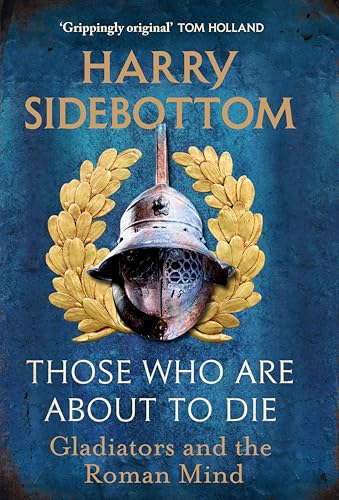
Those Who Are About To Die: Gladiators and the Roman Mind by Harry Sidebottom, is a comprehensive but rather scattergun book on the subject, written with the general reader in mind.
The gladiator anecdotes are organised around the structure of a day, starting with dinner, then sleep, followed by the morning, with the gladiatorial show in the afternoon. It is a loose structure though as the chapters can contain all sorts of random titbits.
It feels like everything the author has ever known about gladiators has found its way onto the page, padded out with additional material on Roman life where gladiator specific references are sparse.
The result is a rather strange smorgasbord of Roman anecdotes, with gladiators as a unifying theme.1
Rather like the introduction to this review, Sidebottom starts each chapter with a few imaginative paragraphs: what a gladiator might feel like as he fights, eats, sleeps and kills.
Dipping in and out
I struggled with this book at first, it was just too much of a jumble of bits and pieces for my taste.
I found that I enjoyed it more when I stopped reading it all the way through, and just dipped into the sections that seemed most interesting to me - handily all the different topics are clearly set out in the contents pages of the book so it is easy to select the parts you want.
So it worked much better when I treated it as an encyclopedia rather than a linear narrative: the “day in the life” thing isn’t consistent enough to provide forward momentum or a satisfying framework.
To help you judge whether this will appeal to you, I have put the full contents of the book into an expandable “details” element, which you can click to read. If enough of the sub topics look appealing, this is a good sign!
Those who are about to die salute you: chapters and sub sections. Click to reveal.
- Vesper (Evening)
- The Cena Libera
- Diet and Body Shape
- Food and Participants
- Backgrounds
- Disgrace and the Elite
- Privacy
- Reasons
- A Mosaic and Conversations
- Revenge
- Prima Vigilia (The First Watch of the Night)
- The Schools
- The Oath
- Training
- Sex
- Secunda Vigilia (The Second Watch of the Night)
- The Measure of Time
- The Difficulties of Sleeping
- The Cult of Sleeplessness
- Sleeping as Weakness and Wickedness
- Sleep and Darkness as Fear and Death
- Tertia Vigilia (The Third Watch of the Night)
- The Importance of Dreams
- How to be a Dream Diviner
- Dreams about Gladiators
- The Dreams of Gladiators
- Quarta Vigilia (The Fourth Watch of the Night)
- Security
- Roman Suicides
- Gladiator Suicides
- Conticinium (Just Before Dawn)
- Popularity
- Anticipation
- Origins and History
- The Colosseum and Amphitheatres
- Justification and Opposition
- Prima Lux (First Light)
- The Procession
- Society Stratified in Stone
- The Salute
- Warm-Up Acts
- Matutinus (Morning)
- Attitudes to Animals
- Events
- Hunting
- Universal Empire: Geography
- Universal Empire: Nature
- Tempus Meridianum (Midday)
- Half-Empty Stands
- Entertainments
- Executions
- Spectacular Executions
- Christians to the Lion!
- Sexual Executions
- Tempus Postmeridianum (Afternoon)
- Last Words and Arrangements
- Types of Gladiators
- The Laws of the Fight
- The Mind of the Gladiator
- Mass Combat
- Defeat, Death and Victory
- Solis Occasus (Sunset)
- Gifts
- Politics and the Crowd
- The Emperor and the Crowd
- Vesper (Evening)
- Magic and Medicine
- The Future of the Games
- The Future of the Gladiator
- Ave atque vale
Fact or historical fiction?
One of the things I liked about Those who are about to die salute you is the gladiator myth-busting. Or more accurately the myth-busting-busting.
For example did gladiators really salute the emperor / presiding bigwig with the phrase ‘those who are about to die salute you’, just before they started fighting?
Sidebottom says: yes, why not?
There only a passing reference to the phrase in the sources: a single anecdote2 told about the emperor Claudius who is said to have made a bad joke in response to the ‘those who are about to die salute you’ salutation, replying “Or not!”. This was taken by the gladiators to be a sign that they didn’t have to fight after all, and much cursing and cajoling was needed to get them back in the mood.
Sidebottom argues that because the phrase is incidental to the point of the anecdote (Claudius’ general idiocy), this makes it more likely to be true: why invent an incidental detail?
Apparently most other ancient historians are not convinced. The reader is free to make up their own mind.
Thumbs up?
Another big gladiator talking point is: was it thumbs up for life and thumbs down for death? Or the other way around?
Among modern scholars it is almost an orthodoxy that the popular belief that thumb down meant death, and up meant life, is the wrong way round. The certainty is misplaced.
Harry Sidebottom, Those who are about to die salute you
The author doesn’t explain why the certainty is misplaced so I guess it is just that there is very little evidence one way or another.
He goes on:
The gesture to grant life was more complex that a simple thumbs up. On the gladiator relief from Munich [see below] a hand emerges... The thumb is turned upwards, the first two fingers extended straight out. We recognise it as the Christian sign of benediction. That might be hugely important, and we will return to it in the last Chapter[^3]. Here it signifies missio, life.
Harry Sidebottom, Those who are about to die salute you
Intriguing! Unfortunately we are left hanging: I couldn’t see any references to this in the last chapter.
Here is the relief sculpture from Munich that Sidebottom is talking about with the apparent thumb single circled.
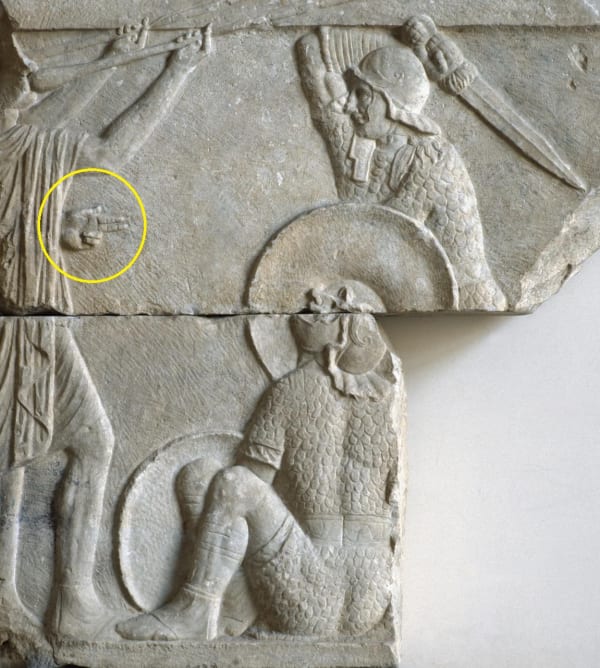
Relief sculpture from the Rome area. Gladiator about to kill a defeated opponent. Late first century BC Staatliche Antikensammlungen und Glyptothek München, inv. Gl. 364. Photo Renate Kühling.
And the same picture again zoomed in.
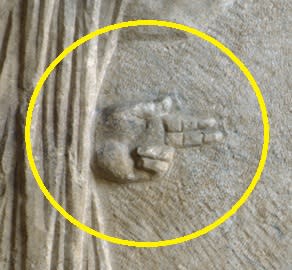
Same sculpture showing the detail of the ‘thumbs up’.
Again, make of that what you will!
Conclusion
If you want an extensive and more-or-less organised compilation of gladiator references from a respected Roman historian - padded out with other tangentally relevant Roman anecdotes - look no further.
If you are after an absorbing page turner that brings the world of the Roman gladiator to life, look elsewhere.
To give you one example of the scattered approach, The Cult of Sleepnessless section starts with an anecdote about Cicero’s snoring neighbour, then to Pliny the Younger and his attachment to his peaceful and secluded suite of rooms, from there to Caligula who ordered a noisy night-time crowd queuing for Circus Maximus tickets be beaten up, then on to the elite’s admiration for studying at night - which didn’t conflict with public service during the day. From here to the most praiseworthy public duty - military service, and an anecdote about a sleepless general. Digress to the fact that Roman emperors monopolised military glory. Anecdotes of three different emperors' nocturnal activities. Then elite statues emphasising their careworn sleepless features. Next: slaves who did not need much sleep were valued. Finally the denouement: gladiators probably would have been well rested so they could fight more effectively and put on a better show! All this crammed into just three pages. ↩︎
Apparently this is a lost source subsequently used by both Suetonius in his The Lives of the Twelve Caesars and Cassius Dio. It is also used in the contemporary secondary source Asterisk the Gladiator. ↩︎
Book details
(back to top)- Title -
Those Who Are About To Die : Gladiators and the Roman Mind
- Author -
Harry Sidebottom
- Publication date -
August 2025
- Publisher -
Hutchinson Heinemann
- Pages -
424
- ISBN 13 -
9781529154009
- Amazon UK -
- Amazon US -
Next post
← AI ate this website and the solution is... more AI.

Last post
New history books in July 2026 →