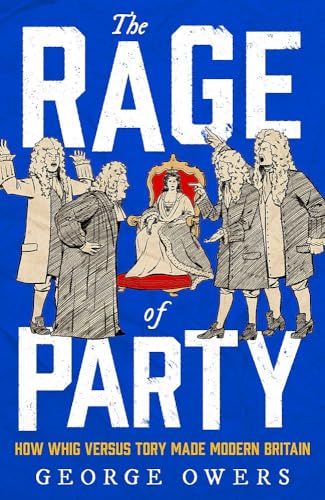
The late seventeenth and early eighteenth centuries are probably among the most significant periods in English and British history, yet they do not loom large in the national consciousness. The years 1688 to 1714, covering the reigns of William and Mary and Anne, witnessed the Glorious Revolution (1688), the establishment of the Bank of England (1694) and the Acts of Union between England and Scotland (1706 to 1707). It was the era which helped lay the foundations for the economic and military dominance of the United Kingdom in the nineteenth century and established a constitutional settlement which endures to this day. Furthermore, as The Rage of Party; how Whig versus Tory made modern Britain by George Owers argues, that era also saw the start of party politics and even ‘culture wars’ which are all too familiar today.
A tale of peculation, betrayal, attempted assassination, whoring, outrageously cynical parliamentary scheming and even sensational accusations of lesbianism.
George Owers, describing his own book, The Rage of Party
The legacy of the Civil War
To understand this era properly, it is helpful to remember that the English Civil War (1642 to 1651) and the Interregnum (1649 to 1660) were within living memory. We may feel that politics today are highly partisan and fractious, but between 1688 and 1714, the idea that politics might ultimately be a matter of life and death was not as far-fetched as we might think.
The fractures left by the Civil War and Cromwellian regime ran deep and go some way towards explaining the sheer hatred and vitriol with which Whigs and Tories regarded one another. It certainly informed the straw-man stereotypes which they sought to besmirch their opponents. Whig politicians portrayed the Tories as crypto-Catholics, seeking to undermine the entire Protestant Reformation on the altar of Stuart loyalism; while the Tories portrayed their opponents as closet atheists and republicans who would drag England back to the worst excesses of Cromwell’s England.
In each case, the stereotypes are mostly false but often had a grain of truth. Thomas Wharton, 1st Marquess of Wharton, one of the leading members of the ‘Whig Junto’ that dominated politics, was notorious for drunkenly breaking into a church where he allegedly urinated on the altar and then defecated in the pulpit.
It’s simplistic, but not entirely unfair, to see the Tories as the heirs of the Cavaliers, whilst the Whigs took up the baton from the Roundheads.
Culture wars
Demure, conscientious, prick-eared vermin.
a Tory pamphleteer describing Whigs, The Rage of Party
Owers repeatedly suggests that the Whigs regarded the Tories as ‘deplorables’, implicitly drawing parallels with how Hilary Clinton described Republican voters during the 2016 US presidential election campaign. Whigs saw themselves as England’s natural ruling class (as demonstrated by their tone of entitlement and frustrated rage whenever Queen Anne attempted to marginalise them) and concurrently viewed the Tories as unsophisticated rustics clinging to outdated ideals. As with many aspects of this time, there is, as George Owers puts it, the ‘uncanny sense of being both recognisable and strange’.
The idea of a political elite whose values are out of sync with the broader public may seem familiar today, but the issues about which those frictions occur have changed significantly. Above all else, for Tories, it was the Church of England, and its supposed endangerment by atheistic Whig radicals, which served as a rallying cry for much of this era.
This is best illustrated by the furore over a sermon by Dr Henry Sacheverell, an Anglican clergyman whose ‘presumption, spleen and shamelessness are apt to take the breath away even at three hundred years’ distance’. He was, like many of the characters in this book, a roaring alcoholic and charlatan. On 5 November 1709, he preached a sermon at St Paul’s Cathedral which was a passionate attack on Dissenters and their sympathisers in the political establishment (i.e. the Whigs). The reaction, both in favour and against his views, was so violent that Whigs had him impeached in the House of Commons, which ordered that his sermon should be ritually burnt. He became a martyr to Tory England and inspired riots in his favour across England in 1710. The author tells us that he even became a ‘sex-symbol’ and ‘pin-up for Tory ladies’.
In terms of what ordinary people thought, we cannot know with any certainty, but Owers speculates that it was probably Tory rather than Whig values which resonated with most ordinary people at that time, voters and non-voters alike, which may help explain their consistent electoral success, even in periods when the powers of government patronage lay in the hands of the Whigs.
Violence
The threat, and at times the reality, of violence is a running theme throughout this book.
In 1683, there was a plot to assassinate Charles II and his brother James which may have involved some of the leading Whig politicians of the day. Owers notes that the accusations of Jacobitism made against the Tories were effectively accusations of treason, for which the penalty was beheading. Tories may have felt relatively secure in their lives (if not their political fortunes) under Queen Anne, but many were probably concerned for their safety under the impending Hanoverian succession, with Whig propaganda particularly effective at persuading the future George I that the Tories were his mortal enemies.
It was also an age in which duelling was still an established way of settling political feuds. Charles, Lord Mohun, ‘was addicted to drinking and whoring only slightly less than his real passion in life: violence’. He fought his first duel at 15 and by the age of 21 had already been tried for murder twice in front of the House of Lords (peers could claim the privilege of trial before their equals).
Lord Mohun (a Whig) and the Duke of Hamilton (a Tory) were bitter political and personal enemies. They had also been in dispute for over ten years over rival claims to a sizable estate. In 1712, the rivalry came to blows, with a duel fought between the two. Hamilton prevailed in the duel with a mortal blow to Lord Mohun’s groin. But the Duke of Hamilton also died, and the circumstances of his death were unclear: the Whig version was that he died of wounds from the duel. The Tories claimed that whilst Hamilton was on the ground helping Mohun, he was stabbed in the back from Mohun’s second MacCartney (a man who himself had a shady past – in 1709 Queen Anne had dismissed him from his army commission for raping a clergyman’s widow). Tories suspected that Hamilton was killed at the instigation of the Duke of Marlborough to prevent him taking up a post as Ambassador to France.
How to fight an election
He was so unlike Mankind, that an Indictment is preferred against his Wife at the Old-Baily for Bestiality, where he is to prove what species he is of.
a Tory referring to Henry Care (aka ‘Monkey Care’) (a Whig publisher), The Rage of Party
Elections in this period were a lot more fun than nowadays. About one in four adult males had the vote; many expected to be lavished with food and drink in exchange for their vote. One candidate issued tickets which could be redeemed for ale later in exchange for a pledge to vote for the right candidate. Richard Steele (a Whig) offered a cash prize for the baby born nearest to exactly nine months after the election. The theory was that by providing wives with a financial incentive to show affection to their husbands at the time of the election, he would endear himself to the husbands (his theory worked – he won the election).
Elections involved vast quantities of alcohol: political agents would often go from household to household sharing a jug of ale with prospective voters. One Tory agent fell into the River Eden and drowned after a day canvassing for votes.
If the carrot did not work, candidates and their supporters could, and did, employ the stick (sometimes literally). One priest threatened his congregation with damnation if they did not vote for his preferred candidate. A sheriff adjourned a poll in Hampshire to the Isle of Wight to discourage voting. In one contest, we are told that Tory tactics against their Whig opponents included ‘beating them with sticks, imprisoning them on false pretences, and, in one case, attempted strangulation’.
What I thought of it
What I particularly enjoyed about this book was that as well as being immensely entertaining, it also helped me understand a period of which I previously only had a hazy conception. The author manages to combine the colour of individual personalities and rivalries with the ability to understand the structural forces acting on England at the time, while also putting political events in the context of a broader sweep of British history.
We are told that Whigs were at the centre of the ‘great engine of taxation, debt and war that emerged in the 1690s’. They were consistently more enthusiastic for an aggressive foreign policy, which was funded by taxes on land, borne largely by the landed gentry, among whom Tory support was particularly strong. Conversely, the system of national debt established by the Bank of England generated profits for City financiers, many of whom were Dissenters and most of whom were Whigs. For rural England, economic and cultural grievance intermingled to toxic effect.
Fake news
Another aspect of the book that I particularly liked is the perspective it provides on modern complaints about politics. I often read that the World Wide Web and social media have exacerbated political echo chambers, fake news and conspiracy theories. But those issues were also rampant in the reigns of William and Mary and Anne.
The Whigs loved conspiracy theories involving Roman Catholics. They also spread salacious rumours regarding the relationship of Queen Anne with her favourite Abigail Hill (later Lady Marsham) and sent the latter death threats.
Perhaps the age when most people got their information from (in the UK) the BBC was merely a brief interlude related to the dominance of radio and then television. What we are witnessing now may be a return to a historical norm.
Conclusion
This book is a perfect combination of great entertainment and thought-provoking argument and comes highly recommended. It also covers a neglected period of British history which provides an interesting perspective on modern politics.
Book details
(back to top)- Title -
The Rage of Party : How Whig Versus Tory Made Modern Britain
- Author -
George Owers
- Publication date -
September 2025
- Publisher -
Constable
- Pages -
576
- ISBN 13 -
9781408719091
- Podcast episode -
- Amazon UK -
- Amazon US -