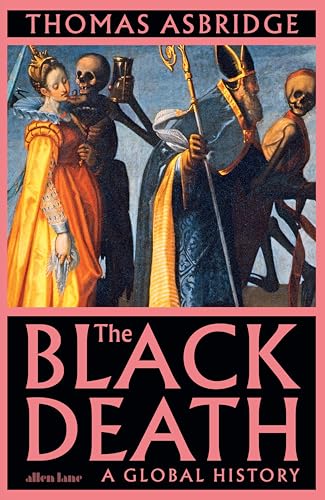
I, Agnolo di Tura, called the Fat, buried my five children with my own hands... It is impossible for the human tongue to recount the awful thing. Indeed, one who did not see such horribleness can be called blessed [and] it was all so horrendous that I, the writer, cannot think of it and so will not continue.
Agnolo do Tura, local shoe maker and part time financial official, quoted in The Black Death by Thomas Asbridge
The Black Death in its first wave from 1347-1353 killed millions of people across Europe, the Middle East and North Africa. Mortality rates differed from place to place but were usually between 25% to 75% of the population. Once the Black Death germ arrived it never went away and returned to decimate populations every 10-15 years for centuries to come.
The numbers of people dying are so large it can be hard to make sense of them.
One attempt is by comparison: for example, at something like 50% mortality, it was over ten times more lethal than the first world war where a little less than 5% of Europe’s population is thought to have perished.
A personal approach
The approach adopted by Thomas Asbridge in The Black Death: A Global History is to focus in on the individual stories of those affected, so we can try to feel and therefore understand what it might have been like. For example, the story of Agnolo do Tura in Sienna above, who described all of his five children dying of the disease. Agnolo also claimed that:
...over the next five months some 80,000 people died in Siena and its suburbs, leaving only 10,000 men in the city, such that the once-bustling streets ‘seemed almost uninhabited’... Shockingly, the city’s total population did not recover to pre-pandemic levels until the early twentieth century.
Thomas Asbridge, The Black Death
How global is global?
Asbridge takes us on a tour of the Europe, North Africa and the Middle East, bringing us tales of disease, suffering and death from:
- Italy (the various city states)
- Spain
- Portugal
- France
- England
- Egypt
- Syria
- Tunisia
- Byzantium
But it is the characters rather than the countries that form the backbone of the book, and we hear from some of the famous and not-so-famous people of this age. To pick a few at random:
- Agnolo di Tura (Sienese shoemaker)
- Clement VI (Avignon Pope)
- Djnaibeg Khan (of the Mongol Golden Horde)
- Geoffrey Chaucer (English writer of Canterbury Tales fame)
- Ibn Battuta (aristocratic Moroccan scholar and traveller)
- Ibn Khaldun (Tunisian scholar and historian)
- Joan of England (who died of the plague in 1348, daughter of Edward III)
- John Lovekin (fishmonger and 14th century mayor of London)
- John Wycliff (English theologian and religious reformer
- Pignol Zucchello (a moderately succesful Tuscan merchant based in Venice - no wikipedia page).
The rest of the world
One thing you might have spotted from the list of countries and people is that while this is certainly an international bunch there are no Asian, Indian or sub-saharan African figures. Given the book’s sub-title of A Global History I was hoping to hear about how the pandemic affected the rest of the world. I think it took until at least halfway through the book before the author explains that no-one really knows the impact of the disease on these non-mediterranean areas so there’s not much to say.
For those interested: the Black Death may have affected China at the same time as Europe and the Middle East - and China may have even been affected first. But because it was one of those periods where the Chinese Empire, long united, was now busy fighting each other, so records are more patchy. As well as this, the language used by Chinese physicians was very different to Western doctors (they were more likely to talk about the pulse than the humours), so this makes it hard to compare symptoms across borders.
In what is now India and Pakistan, it appears as if the Black Death just didn’t have much of an impact. I didn’t do much further digging here but this is still a big mystery to me particularly as (I think) the plague was an issue in the Indian sub-continent in later centuries.
Finally sub-saharan Africa is sadly neglected in the records that we have, and in the subsequent histories, so it is difficult to say much at all.
The worst of times
Back to the Mediterranean then.
Asbridge suggests that the cities which suffered most were those cities in Islamic states which (a) were very populous and (b) didn’t try to flee the disease. The reason the citizens of Islamic didn’t run away whereas the citizens of Christian cities often did if they could1 was that Islamic clerics believed that the Black Death was sent by God to scourge humanity. It was therefore sacrilegious presumption to try to dodge the thunderbolts. The solution instead was to gather together and use the power of prayer to avert disaster. This may have improved morale but it exacerbated the impact.
Cairo was one of the cities that was worst affected:
In all, probably well in excess of 250,000 lives were lost, though the exact figure cannot be determined. [An observer] remarked that ‘the plague destroyed mankind in Cairo’
Thomas Asbridge, The Black Death
Similar medically ill-advised religious gatherings were organised in Christian towns and cathedrals, but there wasn’t the same stigma for those who preferred to just get out of there, which meant that people who had the ability to flee often did.
Finding scapegoats
As well as gathering together the stories of people from different countries, Asbridge also discusses the experience of Jewish people living in Europe during the Black Death. Jewish people were often already viewed with suspicion by the communities in which they lived, and the atmosphere of fear and paranoia accompanying the plague brought out appalling behavior from their neighbours:
...tens of thousands of Jews were killed in this period and, by 1351, more than 200 Jewish communities had been exterminated. In the decades that followed, this persecution prompted the mass migration of surviving Jews into eastern Europe, more than quadrupling Poland’s and Hungary’s Jewish populations.
Thomas Asbridge, The Black Death
Asbridge also highlights the connivance of local authorities as the pandemic progressed. Instead of trying to restrain the violence against Jewish people, as they had sometimes done at the start of plague, officials used the law as an additional weapon:
Terrible as it had been, the first phase of antisemitic violence during the pandemic had been largely condemned by authorities, even when some officials participated. Now, the annihilation of Jewish communities was rapidly lent the veneer of legal authority and covered in the cloak of bureaucratic legitimacy. Thereafter, the persecution was no longer the preserve of incensed mobs. Its victims no longer numbered in the tens or hundreds. Instead, officially sanctioned acts of mass murder targeting thousands became commonplace, as a wave of pogroms swept from Switzerland into Germany.
Thomas Asbridge, The Black Death
What’s in the book
I felt like The Black Death was actually two or three books rolled into one.
- The first section is a survey of the effect of the Black Death and how people reacted
- The second reviews how our knowledge of the disease has progressed and the current medical consensus
- The third section looks at the consequences of the Black Death on the course of humanity more generally
For me the first section on ‘what happened’ was the strongest, the second section on the disease itself was very interesting but felt like an optional appendix, and the third section on the long term effects was weaker: given the Black Death did happen and then stuff happened after the Black Death, maybe the stuff was caused by the Black Death? Like much of speculative history writing it suffers from working with a sample size of one.2
The most interesting snippet that I took from the second section on the medical side of things was that the traditional view of how the Black Death spread - by fleas riding on rats - is certainly only a part of the picture and probably not the most important part. This is because rats are just not fast enough to explain the phenomenal speed of transmission3.
...this ease of transmission cannot be explained by the traditional rat-flea-vector theory alone. In truth, no wholly satisfactory solution to this mystery has yet been presented
Thomas Asbridge, The Black Death
Writing style
The Black Death, despite the subject matter, is pleasant to read, with methodical rather than scintillating prose. The personal stories are the most absorbing. Always welcome: there is also a range of nice pictures at the back.
Conclusion
The Black Death: A Global History successfully combines a broad view of this demographic disaster, with tightly focussed personal stories of tragedy.
It also serves as both a great introduction to the subject and a window on the latest scholarly thinking. Recommended reading!
A famous example is Francesco Petrarch in Italy who both fled affected areas and wrote a book - the Decamaron - about a group of noble-folk telling stories while waiting out the plague in a country house. ↩︎
For example, was the reformation in the early sixteenth century caused by the Black Death in the mid 14th century? Could be, says Asbridge: “While the Church seemed to plunge still deeper into the mire of iniquity during the age of plague, the devastation caused by the Black Death and its aftermath moved many lay Catholics to engage more personally and actively with their faith.” ↩︎
To save you the trouble I have asked AI the average walking speed of a rat, which is plausibly said to be 0.7 kilometres per hour. ↩︎
Book details
(back to top)- Title -
The Black Death : A Global History
- Author -
Thomas Asbridge
- Publication date -
April 2026
- Publisher -
Allen Lane
- Pages -
424
- ISBN 13 -
9780241399408
- Amazon UK -
- Amazon US -