There is general agreement, first, that Cromwell is one of the great figures of British history, and yet also, second, that the nature of that greatness is shrouded in paradox
Ronald Hutton, quoting historian James Colin Davis
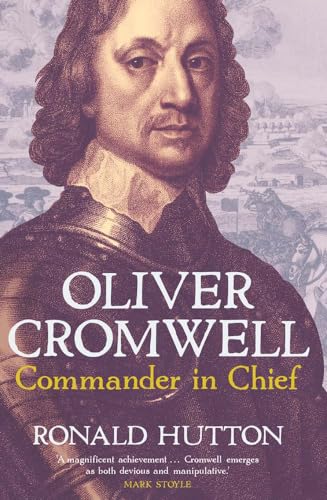
The historian Ronald Hutton, professor at the University of Bristol, has published the first two books in his planned three-book series on the life of Oliver Cromwell, which forms part of the Yale English Monarchs Series.
The first book, published in 2021, covers Cromwell’s life from birth in 1599 to 1647, following the end of the First English Civil War in 1646. This book includes Cromwell’s early life (for which there are few surviving records), his early political career (he became a Member of Parliament in 1628) and his formative years soldiering in the First English Civil War, rising from a cavalry captain to Lieutenant-General of Horse under Sir Thomas Fairfax. This book is battle heavy. During this period Cromwell was first and foremost a soldier, and that is how he established his reputation.
The second book was published in 2024 and picks up the story in 1647 with Oliver Cromwell and his family newly established in London and Cromwell resuming his career as a Member of Parliament. He is soon called back to military service for the short Second Civil War (1648) and campaigns in Ireland (1649-1650) and then Scotland (1650-1651).1 It concludes in 1653, with Cromwell forcibly dissolving Parliament, at which point he has effectively established a military dictatorship over the whole of the British Isles. This book is more of a mixture of politics and warfare than the first. It only covers six years, but those are arguably the most significant and famous six years of Cromwell’s life. For the reasons set out below, I thought this was the stronger of the two books.
A reasonable question may be why I am reviewing two books in a three-book series. I have no particularly good answer, except that: (i) the third book is yet to be published; and (ii) I have just read these two books with the intention of reviewing them, mistakenly believing them to be part of a two-book, not three-book, series. Consider this a preliminary perspective on what will no doubt prove to be the author’s magnum opus.2
Historiography
Given that Cromwell is one of the most written-about people in British history, does Professor Hutton have anything new to say about him? The distinguishing characteristics of these books are a scepticism about taking Cromwell at his own word, and an insistence on perceiving Cromwell in the context of his own times, rather than as a reflection of contemporary politics. The central argument is that Oliver Cromwell was ‘more pragmatic and more devious than the one represented by his own speeches and writings’.
The historiography of Cromwell is a fascinating subject in its own right. For eighteenth and nineteenth century Whigs, Cromwell was a progressive hero. But whilst Cromwell’s impact may have inadvertently resulted in outcomes that we view today as positive (parliamentary democracy, religious tolerance and pluralism) they were hardly ever his objectives.
A bad man?
Devious, ruthless, manipulative and self-seeking
Ronald Hutton, describing Oliver Cromwell
Over the combined 727 pages of the two books, I was left with the impression that Ronald Hutton does not like Oliver Cromwell. Does that make his biography unreliable or unbalanced? I don’t think so, or perhaps only subtly or marginally. He clearly knows his subject matter inside out and is utterly meticulous and scrupulously fair in laying out all available evidence, particularly for the most contentious topics, such as the Siege of Drogheda.
Having said that, there are times when the author strains to interpret actions and events in the worst possible light for Cromwell. When Cromwell reforms the legal system in Ireland to provide more opportunities for Catholic tenants to seek redress from landlords, we are told that this was to ‘win their gratitude and make them more inclined to convert to Protestantism’, which struck me as a bit of a ‘damned if he does, damned if he doesn’t’ situation.
Cromwell’s remarkably successful military career is repeatedly ascribed to luck, whilst praise is begrudging – he is described ‘a competent trickster’ and we are told of his ‘methodical efficiency’. One of the most striking facts about Cromwell is that he first became a soldier at the age of 43, having had no previous professional military experience, and then went on to become one of the most successful soldiers in British history. The book could have done more to explain that success, apart from recourse to luck alone.
Whatever Cromwell’s many faults, he is a role model for a mid-life career change.
Cromwell’s publicity machine
The problem any biographer of Cromwell faces is the frequent lack of evidence, which Hutton himself admits on a number of occasions. That vacuum then provides the space for interpretations of the few sources there are in a more or less flattering way for Cromwell.
For example, there are repeated references in these books to the way in which the London press would exaggerate the role of Cromwell in military successes, whilst downplaying the role of others. But there is little (in fact, as far as I could tell, no) evidence linking Cromwell to any specific person in the London press – so instead we have vague references to ‘Oliver’s allies in the London press’ and his ‘publicity machine – whoever was running it’.
Elsewhere the author admits that ‘at no point is it clear how directly Oliver himself was involved in representations of himself in the press, and how much they were controlled by friends and well-wishers. What can be said is that the admiring portraits of his actions that were published would not have appeared so consistently had he not condoned or encouraged them’. ‘Condoning’ (or even ‘encouraging’) a positive portrayal hardly seems the most damning accusation to ever have been made against a politician.
The Elect
A natural holy warrior, a Puritan jihadi
Ronald Hutton, describing Oliver Cromwell
The author convincingly argues that it is misleading to see Cromwell through the prism of contemporary values.3 Past historians have made the mistake of casting Cromwell as a sort of proto-liberal, arguing for religious pluralism and tolerance. But the tolerance he advocated only applied to the type of Puritanism he favoured. He was never in favour of allowing tolerance to Roman Catholics or, for that matter, traditional Anglicans. He argued for the right of ‘independents’ to worship outside the official Church, but that was probably a pragmatic solution to the fact that most of the political elite and the country at large had little appetite for the type of religion he favoured. It is perfectly conceivable that if he could have found a way of making his brand Puritanism the ‘official’ version, his views on tolerance of religious minorities would have adjusted accordingly.4
Seen in this way, his career, and that of the army with which he was always closely associated, can appear as a successive process of narrowing down the ruling class to those who shared their own outlook.
- First, he fought alongside Parliament to defeat the Royalists and therefore traditional Anglicanism.
- Then, with Pride’s Purge in December 1648, the New Model Army prevented most of Parliament’s Presbyterians from taking their seats (leaving the so-called Rump Parliament).
- Finally, on 20 April 1653, Cromwell and 40 musketeers forcibly dissolved a Parliament unwilling to bend to the wishes of the army independents.
At no point is there any indication that Cromwell questioned the legitimacy of what he was doing. In fact, one of the principal factors which may have led to Cromwell’s decision to forcibly dissolve Parliament in 1653 may have been a discussion he had with Parliamentary leaders at his home the preceding evening: in those discussions, Cromwell and fellow army independents asked how they could have assurances that new elections would only return the ‘right sort’ of persons (by which they meant those who agreed with them).
It may have been the failure of Parliamentary leaders to provide a convincing response to that question (realistically, how could a mechanism be devised which would exclude all Anglicans and Presbyterians from office?) that prompted Cromwell to take decisive action the following morning. In private letters, Cromwell was explicit in his belief that a ‘godly minority’ had the right to exclude from power an ‘ungodly majority’. Cromwell viewed the world ‘as divided into the followers and enemies of God’. It’s an object lesson on the dangers of the politically and morally self-righteous.
A pre-Enlightenment revolution
This book made me think about how Cromwell compares to later revolutionaries. Perhaps some historians have tried to interpret England’s overthrow of its King5 in the seventeenth century as a dry run for the later eighteenth century American and French revolutions. But what becomes clear from this book is that Oliver Cromwell was a product of a pre-Enlightenment Europe. Whilst Jefferson and Lafayette were inspired by Enlightenment ideas about human rights and freedom, Cromwell was more interested in his God and doing what he thought his God wanted him to do.6 To what extent other protagonists in the English Civil Wars were motivated by nascent ideas about human freedom and liberty is an interesting question.7
Summary of charges and defences
A poor weak creature, and not worthy of the name of a worm, yet accepted to serve the Lord and his people
Cromwell describing himself, in a letter to a fellow Puritan in Massachusetts
In the interests of fairness, I will attempt to summarise possible charges against Cromwell’s character and how I assess the weight of evidence for each:
-
Was Cromwell bloodthirsty and excessively harsh to opponents by the standards of his time? We are told that Cromwell 'had a savage streak in his nature which enjoyed inflicting death, injury or humiliation of those against whom he had taken'. Elsewhere we are told that Cromwell 'had always been a killer' and that his cavalry had 'long taken pleasure in killing'. Instinctively, I expect this may be right - but these claims are a bit speculative based on the sources available. Another interpretation is that he was just good at his job of being a soldier, which after all did involve killing people, and that tended to irritate people he was up against. There is a lack of substantial proof of him breaching the conventions of warfare which prevailed at the time. On the other hand, it can be shown that Cromwell was willing to treat enemies leniently when it was prudent (or expected) to do so. He was also strict about military discipline when it came to matters involving the interaction of his soldiers with civilians – he was willing to hang his own soldiers for pillaging locals. I had a feeling that if I was a neutral civilian, I would not necessarily want to encounter Cromwell and his soldiers, but that there may have been worse alternatives.
-
These books present an image of Cromwell as good at self-publicity and politically manipulative. As mentioned above, I am not convinced that Cromwell had an organised 'publicity machine' in London, but there are plenty of examples of his tendency to exaggerate his own role in military successes whilst downplaying the role of others. There are also occasions when he can be shown to have lied to or misled Parliament. Cromwell's way of speaking has a slightly annoying quality of feigned8 simplicity and piety (whilst obscuring points of contention) which smacks of hypocrisy to a modern audience.
-
Was Cromwell politically and religiously self-righteous with an inherent belief in his right to exclude from power those he disagreed with? Yes, I think after reading these two books I am thoroughly convinced that this was the case. Given that his entire belief system was based on the view that he belonged to a tiny predestined religious elect, perhaps it is not surprising that he was not a natural democrat.
What did I think of the books?
These books are good at describing and explaining the logistics of seventeenth century warfare and doing so in a way that is not tedious. As I mentioned earlier, one of the notable features of Cromwell’s life is his recurring success in battle. A significant contributing factor to that was that he was consistently supported by a Parliament with the means and willingness to supply him with the things he and his army needed to successfully prosecute his campaigns. The level of granular detail given also brings to life the day-to-day life of the soldiers fighting with Cromwell effectively. At times, their lack of food inspired me to take a quick break for a snack, lest I also suffer from the effects of malnutrition.
Another way in which the author manages to bring the world of seventeenth century Britain to life is in his detailed descriptions of the flora, fauna, sights, smells and sounds of the landscapes through which Cromwell and his armies passed.9 The natural world is clearly a particular passion for Ronald Hutton, and he manages to evoke this vividly. It is highly idiosyncratic for a history book (I struggle to think of another example which does this to the same extent), but I felt it was effective.
The writing style is highly distinctive – the author combines meticulous examination of source evidence (for instance, a detailed examination of Oliver Cromwell’s opinions on drainage of the Fens in book one) with the occasional unsubstantiated sweeping statement. Early in the first book he claims that the English ‘traditionally despised’ the Scottish people as ‘inferior’. Elsewhere, he makes a similarly sweeping claim about English views of the Welsh. He can also be entertainingly catty in his descriptions: Grey of Groby (a Parliamentarian soldier) is described as ‘a classic dim-witted posh boy: young, genial, weak-willed and hesitant’, whilst Sir John Hotham (another Parliamentarian soldier, later executed with his son by Parliament for treachery) is described as ‘rich, arrogant, conceited, duplicitous and fundamentally inept’.
I preferred the second book over the first book. The first book gets off to a slow start because of the paucity of surviving information for Cromwell’s early life. This is something we are repeatedly reminded of; after the first few dozen pages, I started to dread reading phrases such as ‘we don’t know’ and ‘it is not clear’ – a more general disclaimer would have sufficed for much of this section. The evidence and the book improve significantly, in lockstep, as Cromwell’s political and military career progresses.
In the second book, the author is more willing, or able, to step back and see the wood for the trees; provide some perspective and add some insights to his obvious exhaustive knowledge of the subject matter. If I was rating the two books individually, I’d give the first book three stars and the second book five stars, so four stars is an average for the two. Overall, the two books together are highly rewarding and I’m looking forward to the third.
Conclusion
The Cromwell that emerges from these two books is a much more slippery character than I had previously appreciated. With some minor caveats, I found the characterisation of Oliver Cromwell in these books entirely plausible. The author combines exacting standards of scholarship with a unique writing style to create what was, for me, one of the most entertaining and enlightening historical biographies I have read.
Regarding the Scottish campaign, it is noted that ‘Scotland’s acceptance of Charles II had cost it very dear: for the only time in its entire history, it had been properly conquered by the English, and in the process had probably lost around 10 per cent of its entire adult made population, a casualty rate exceeding that of any European state in either the First or Second World War’. Having a quick look at the Wikipedia pages on casualties in the First or Second World Wars, I think this is debatable, but I am not qualified to comment on the accuracy of this claim. ↩︎
I will certainly read the third book when it comes out and may review that one separately when it does. ↩︎
A useful piece of advice for many modern historians. ↩︎
A counterargument would point to Oliver Cromwell’s encouragement of Jews to move to England, which perhaps indicates a more general willingness to tolerate alternative religions. I expect this will be addressed in book three. ↩︎
The point is made that Charles I was also king of Scotland and Ireland at the time, but that the Scots and Irish didn’t get any say in the decision to execute him. ↩︎
This was a motivation which Cromwell shared with many of those involved in the events of this era, albeit religious motivations could lead in different directions. Ronald Hutton points out that Charles I was strongly driven by his commitment to traditional Anglicanism - his refusal to compromise on some of his own beliefs probably contributed to his execution. ↩︎
The Blazing World by Jonathan Healey (reviewed by me elsewhere on this website) notes that many involved on the Parliamentary side in the English Civil Wars were influenced by deeply held beliefs about the constitution and the accountability of those in power to those they ruled. ↩︎
As in, it sounds feigned to a modern audience – like many successful politicians, Cromwell probably believed his own propaganda. ↩︎
The author admits that there is little indication that Cromwell himself had any interest in the natural world. ↩︎
Book details
(back to top)- Title -
Oliver Cromwell : Commander in Chief
- Author -
Ronald Hutton
- Publication date -
August 2024
- Publisher -
Yale University Press
- Pages -
485
- ISBN 13 -
9780300278941
- Amazon UK -
- Amazon US -