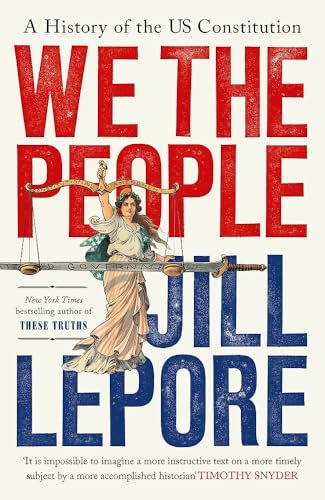
Asked in 2025 whether he had a duty to uphold the U.S. Constitution Trump said, 'I don't know.' >>> Jill Lepore, We the People
This book was a birthday present from our website founder, Anthony Webb. It's quite a departure for me. I admit to knowing very little about American history. So, it's good to get a bit of exposure to an area of history about which I know little.
The Amendments Project
The book is the product of the Amendments Project (of which the Jill Lepore is the Project Director) described on its website as a 'searchable archive of the full text of nearly every amendment to the U.S. Constitution proposed in Congress between 1789 and 2022 (more than 11,000 proposals); records of petitions introduced in Congress between 1789 and 1949 that propose, support, or oppose constitutional amendments (more than 9,000 petitions); and thousands of proposed amendments that never made it to Congress'. Of those thousands of proposed amendments, thirty-three have been proposed by the United States Congress and sent to the states for ratification, and twenty-seven have been ratified by the states and now form part of the Constitution. Of those twenty-seven successful amendments, one amendment (the twenty-first) repeals the eighteenth amendment (prohibiting the manufacturing or sale of alcohol).
The Amendments Project states that 'since the 1970s, the U.S. Constitution has become effectively un-amendable, chiefly due to widening political polarization'. A central contention of the book appears to be that the Constitution is too difficult to amend. To consider this, it's worth taking a moment to consider the process for amending the Constitution, which I didn't understand prior to reading this book.
How to amend the constitution
The amendment process is set out in Article V of the Constitution. It's a two-stage process:
- Firstly, an amendment must be proposed. This can be done in one of two ways:
- by the U.S. Congress, with the approval of a two-thirds majority in both the Senate and the House of Representatives; or
- by a national convention, which can be requested by the legislature of two-thirds of the states. This option has never been used.
- Secondly, a proposed amendment is sent to the states for ratification. Ratification can either be from:
- the legislatures of three-fourths of the states; or
- approval by state ratifying conventions in three-fourths of the states. The only amendment to be ratified by this method is the twenty-first amendment repealing prohibition.
So, essentially, amendment has almost always followed option 'a' for both proposal and ratification (i.e. proposed by U.S. Congress followed by ratification by state legislatures).
Under Article V, one provision is unamendable (without the consent of all states): equal representation in the Senate (i.e. each state gets two senators, regardless of the population of the state).
Original sin
For me, the most interesting parts of the book were the opening chapters exploring the drafting and ratification of the Constitution. I enjoyed the insights into American society at that time and the Founding Fathers.
Slavery looms large in American history, which will come as a surprise to nobody. The cracks in American politics were there from the start. Vermont's first constitution, drafted in 1777, prohibited slavery. But the right to own slaves was passionately defended by the Southern states at the U.S. Constitutional Convention in 1787. Slavery infused the public and private lives of many of the Founding Fathers. Thomas Jefferson had multiple children with his slave, Sally Hemings. Those children were born into slavery. The idea of someone's child also being their slave struck me as peculiar. But apparently it was quite common in certain circles. In fact, Sally's own mother was her father's slave, and Sally was her father's slave.1
After a lot of back and forth and heated arguments, the 1787 Constitution eventually permitted slavery, without actually using that word (which was considered to be too much of a stain), because the alternative would have been the Southern states seceding from the Union (which they tried to do during the Civil War when the issue came up again). The Constitution also contained the very strange 'three-fifths rule', by which slaves counted as 'three-fifths' of a person for the purposes of the apportionment of seats in the House of Representatives, even though those 'persons' had no right to exercise votes themselves. In this way, the Southern states got to have their cake (slavery) and eat it (over-representation in the House of Representatives). If nothing else, that proves the power of obstinacy as a negotiating tactic.
What is the point of a constitution?
A text is made of woven letters; a textile is made of woven threads
Jill Lepore, We the People
Two themes which come from the book are that the author thinks the Constitution is too difficult to amend (she tells us that 'Article V hasn't worked since 1971'); and that she is opposed to (or at least sceptical about) 'originalism' (which is a theory of constitutional interpretation which seeks to understand the intention of the persons who wrote and ratified the Constitution) and instead favours the idea of the Constitution as a 'living organism'2.
At times, I would have liked the book to have dug a little deeper into some of the questions which lay beneath its surface. For example, what is the purpose of a written constitution and 'fundamental' law (i.e. laws that cannot be amended except by a supermajority)? It's a question the book never addresses.
A fair defence might be that this is a book of history, rather than political science. Nonetheless, some of the themes which are raised by the book are difficult to properly assess without posing some of those questions. For example, if the idea of fundamental law is to make some laws more difficult to change than others, then surely changing a constitution should be difficult?
Antonin Scalia (a Supreme Court judge 1986 to 2016) said the whole purpose of the Constitution was to prevent change. On a purely logical level, doesn't he have a point? Plenty of fair criticisms can be made of the people and process by which the original Constitution was drafted and agreed – in particular, the persons doing so were unrepresentative of the world they lived in. No women, black men, or indigenous Americans were present at the Constitutional Convention held in Philadelphia in 1787.
But that raises a fundamental dilemma which the book never addresses. If it is unfair for one generation to create laws which bind a future generation, then can a written constitution ever be legitimate? The UK has statutory provisions still in force which date back to the thirteenth century,3 but those can be repealed or amended at any time by an Act of Parliament, as the UK is one of the few countries in the world which does not have a written constitution. I would have been interested to hear what the author thought the value of a written constitution is and how such a document can have democratic legitimacy.
Constitutional politics
It seems history matters to this Court only when it is convenient
Justice Sonia Sotomayor reacting to Trump v. United States
American constitutional history is a window into the strange world of American politics. American politics may be polarised, but certain ideas enjoy broad cross-party appeal – for example, that imposing your political views on others through Constitutional amendment and/or interpretation is a good idea.
An American political novice might ask why people who favour or oppose something (for example, guns, abortion) don't merely seek to pass (or oppose the passing) of state or federal laws which favour their own perspective. But for the politically [or morally? ed] motivated American, of left or right, having their own opinion enshrined in the Constitution or validated by the Supreme Court always appears to be the more attractive option.
What did I think of the book?
We have at last so far got through the wearisome business of amendments, we may never hear any more of it
Benjamin Goodhue, delegate to the U.S. Constitutional Convention, 23 August 1787
The above quote came to mind as I made my way through 581 pages of petitions and sub-committees. The opening of the book, dealing with the founding of the United States, is very interesting, as was parts of it dealing with the Civil War period, but I found some of the other sections a bit long-winded and digressive – there's a lot about the constitutional history of Hawai'i which, whilst interesting, might have benefited from being more succinct.4
The author tells us that the 'countless numbers' of constitutional amendments which have failed 'count for rather a lot'. They are certainly a fascinating perspective on the debates which have raged about the Constitution from its inception. One proposal for an amendment of the Constitution would have led to the development of an 'Intergalactic AMERICA'. I expect this idea would find favour with the current administration.
Conclusion
The heavens turned. Wars were won and lost. Constitutions were written and rewritten. A republic became an empire and once more a republic. The grass grew, the sun rose, the seas spread, and the waters ran red with blood.
Jill Lepore, We the People5
This book has much to recommend it. It is obviously the product of enormous and meticulous research. It is also very timely, given the many stresses and strains which America's system of checks and balances is currently being subjected to. I think Anthony bought this for me hoping that it would be a ringing endorsement of an idea and document under threat of neglect. Strangely, the author's perspective on the Constitution is quite sceptical, in respect of both its origins and its subsequent resistance to change.
Sally Haming's father was John Wayles. He had a legitimate daughter called Martha Wayles who married Jefferson, which made her Sally's half-sister. ↩︎
Unless I missed it, I don't believe the book ever provides an explanation of what this means. I suspect an 'originalist' would argue that it means judges inventing constitutional rights depending on their own politics. I would have been interested to hear the author's counterargument to that. ↩︎
The oldest English statute still in force is the Statute of Marlborough (1267) which I am informed by ChatGPT is 'older than Downton Abbey'. ↩︎
The author uses the story of a quilt made by Queen Liliʻuokalani of Hawai'i whilst imprisoned, reflecting on aspects of Hawai'ian history, as a framework for this section of the book, which I did feel was an effective device. ↩︎
The author is keen on the occasional rhetorical flourish, which is hopefully evident from some of the quotes given here. ↩︎
Book details
(back to top)- Title -
We the People : A History of the US Constitution
- Author -
Jill Lepore
- Publication date -
September 2025
- Publisher -
John Murray
- Pages -
720
- ISBN 13 -
9781399827041
- Amazon UK -
- Amazon US -