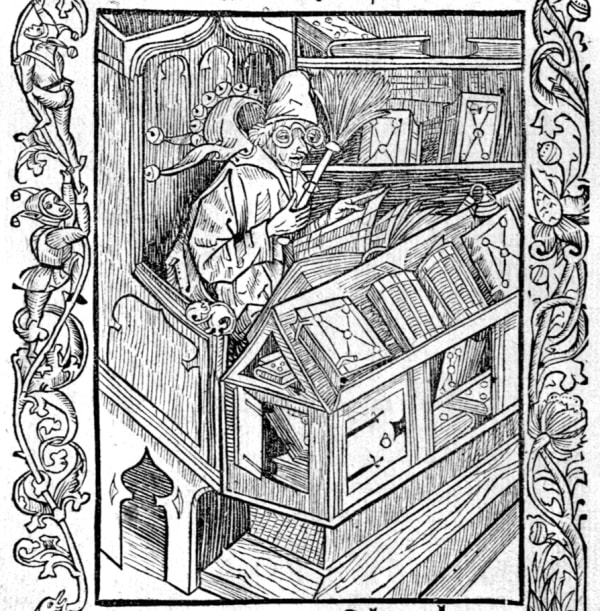
Of splendid books I own no end
But few that I can comprehend.
I cherish books from various ages
And keep the flies from off the pages.Sebastian Brant, The Ship of Fools (1494)
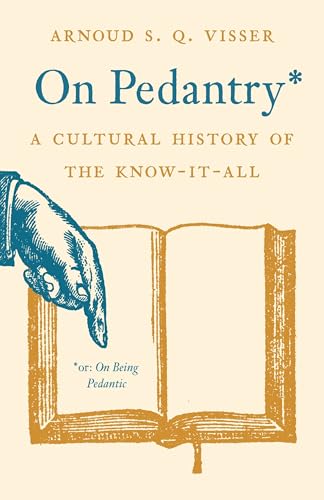
The rhyme reciting bibliophile quoted above is one of the many Western European (and North American) pedants that Arnoud Visser introduces to us in On Pedantry: A Cultural History of the Know-It-All.
One interesting fact about this bibliophile buffoon is that he is the very first nitwit out of the over 100 different types of fools that Brant included in his hugely influential book, which aimed to catalogue every type of nincompoop. Clearly the literary pedant - who loved his books dearly but never read any of them - was expected to strike a chord with readers 500 years ago. As indeed he does with me today!
What is a pedant?
But is he really a pedant? I don’t want to come across as pedantic myself of course, but I would have labelled him as an idiot more than anything else, or perhaps a chump.
When I was a child for example, my mum, whenever she felt I was winning an argument on a technicality, would say to me with great relish: “You pedant!” suggesting that for her pedantry meant priggishly insisting on minor points and willfully ignoring what really matters.
However, as Visser tells us, the definition of what a pedant is has shifted over the past thousand years or so: but at the heart of the accusation of pedantry is someone who is considered insufferably intellectual in one way or another.
Which means that this book is fundamentally a history of anti-intellectualism, told through the lens of various eggheads who got up other people’s noses.
Grumbling Greeks
So where did it all start? Visser kicks off with the ancient Greeks and specifically the Athenians, reminding us that despite all the philosophers “it was also a culture with strong anti-intellectual sentiments”.
“Sophists” in particular were a target of the brainbox bashers. Tutors to the very rich, sophists would train them in the arts of rhetoric and argument. However their financial motivation and potentially slippery attitude to right and wrong was problematic.
The play ‘The Clouds’ written by Aristophanes in 423 BCE humorously riffs on these attitudes.
Cloudy reasoning
The story of the play follows a young man called Pheidippides who has been sent to the sophist ‘Thinking Institute’ by his father, in order to become sufficiently skilled at argument to get dad off the hook for his mounting debts.
The plan is initially a success, and Pheidippides comes up with an ingenious yet specious logic to get out of paying up “based on the ambiguous naming of the final days of the month on which the debts were due”.
Unfortunately Pheidippides doesn’t stop there and also beats his father up (I’m not totally sure why), devising another argument to justify this shocking and unsettling behaviour.
Heated debate
Ultimately the father, also under the influence of the Sophists, goes slightly mad and denies the existence of the gods, before coming to his senses and burning the Thinking Institute to the ground.
The Sophists in the play, while ludicrous, are also a subversive and potentially dangerous element in Athenian society. Knowledge is a dangerous thing, if not anchored by upright morals.
Reproachful Romans
The journey through Western civilization continues with the Romans who had a love-hate relationship with intellectuals. Visser notes that:
In the first century a range of emperors, including Nero, Vespasian and Domitian, had issued decrees expelling philosophers from Rome, or even Italy as a whole.
Arnoud S. Q. Visser, On Pedantry
Critical Christians
Then onto the middle ages where learning went hand in hand with Christianity. Tenth century intellectualism had at its core an intimate master-student relationship: correspondence between students and masters is apparently full of dramatic protestations of affection. “Countless tears are wept, jealous suspicions thrown about, sweet wishes uttered.”
When a new school of thought, scholasticism, emerged in the twelfth century, based on logic rather than practical ethics, the “old qualities of charismatic masters... came to be seen as pompous, verbose pedantry.”
Horrendous Humanists
On to the Renaissance, where uppity humanists, were associated with sexual deviancy and sodomy despite the fact that “teachers and students [in Florence] represent only 0.6% of cases in the records of the criminal tribunal for sodomy.” These derogatory accusations, Visser tells us, stemmed from the nobility who felt threatened and affronted by these free-thinking jumped-up big-mouthed smart-alecs.
Founding Philistines
The last part of the book heads over to North America where anti-intellectualism is present from the inception of the United States: Thomas Paine chose to write the foundational text “The Rights of Man” in a deliberately home-spun and plain-speaking style.
Fifty years later the 1828 presidential election pitted the intellectually inclined incumbent John Quincy Adams against Andrew Jackson, a “barely literate” war hero. The electorate had just been expanded: you no longer needed to own property to vote. And some of the new voters at least felt that literary dexterity was a disqualification for high office. “I never found a dictionary man who was not half a fool - I’m for Hickory [Andrew Jackson], I believe” one farmer reportedly said. Andrew Jackson won the election.
The last chapter homes in on pedantic professors in the twentieth century who, when negatively portrayed in the first half of the century, were shown as authoritarian bullies, and then often as pathetic misfits in the second half of the century, as their purchasing power parity declined.
Style guide
On Pedantry is probably the most readable history of anti-intellectualism that you will come across. Visser has a dry sense of humour and is always on the lookout for a good anecdote. I liked the way he started each chapter with a dictionary definition, a tongue in check homage to the pedantic dictionary men and women.
That said, it is not really a page turner and as a reader you have to put a certain amount of effort in to stay with it.
Conclusion
What I liked most about the book was the way it contextualised the anti-intellectualism that we come across nowadays.
By presenting a long history of anti-intellectualism essentially as a power struggle between competing world views (in which the accusation of pedantry is often just a handy weapon) it helped me to think about the power struggles of today from a new angle. It also gave me a new way to think about the power struggles with my mum two or three decades ago!
Book details
(back to top)- Title -
On Pedantry : A Cultural History of the Know-it-All
- Author -
Arnoud S. Q. Visser
- Publication date -
November 2025
- Publisher -
Princeton University Press
- Pages -
344
- ISBN 13 -
9780691257563
- Amazon UK -
- Amazon US -
Next post
← New history books in February 2026

Last post
New history books in Jan 2026 (and Dec 2025) →