Ancient Egypt has a history that spans an incredible amount of time. From 3100 BCE to 30 BCE there are 31 centuries, covering 33 dynasties, and 390 different pharaohs.1
When my ancestors were feeling pleased with themselves for putting one stone on top of another stone at Stonehenge in ancient Britain, the Egyptians were piling up 2.3 million blocks of stone to make the Great Pyramid: 210 layers high2.
It is all pretty impressive.
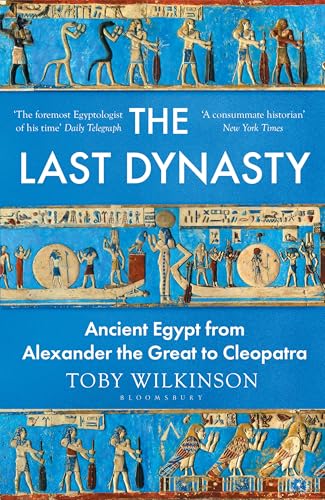
Which is perhaps why it is easy to overlook the odd few centuries here and there, a case in point being the last three centuries of Pharaonic Egypt, ruled over by the (Greek) Ptolemies. The only two I could have named before reading The Last Dynasty: Ancient Egypt from Alexander the Great to Cleopatra by Toby Wilkinson were Ptolemy (the first one who was friends with Alexander the Great) and Cleopatra (the last one, who killed herself with (possibly) an asp).
Apparently I am not alone - Wilkinson tells us that this period is too late for the Egyptologists and too early for the Romanists - and so tends to get neglected. The oddity is that, measured by longevity, this is the most successful dynasty in the entire history of Egypt, at almost 300 years long.3 The Last Dynasty fills in this lacuna and introduces us to the full range of characters during the Ptolemaic dynasty, most of which are also called Ptolemy or Cleopatra, which makes them easy to remember but hard to tell apart.
A Ptotted History
So what happened?
It all starts with Alexander the Great, who conquers Egypt and everywhere else then dies. His general and childhood buddy Ptolemy gets his hands on Egypt in 323 BCE.
Ptolemy I is relatively unusual in trying to get along with the people he has conquered, even going to the extent of inventing a new god ‘Serapis’ to bring his Greek and Egyptian people together (“one of only a few historically attested examples of an invented deity”).
Ptolemy I has a son (also called Ptolemy) who succeeds in turn. Scandalously for his Greek subjects Ptolemy II divorced his first wife to marry his sister Arsinoe II. By contrast his Egyptian peoples considered this a sensible policy for a happier Egypt.
The Ptolemies were good at ostentation and Wilkinson describes the first Ptolemaieia - which was a sort of rival Olympic games. The opening parade through Alexandria was just as over the top as some of the modern Olympic opening ceremonies, including animals, fancy dress, treasure and:
a float bearing a 180-foot-long golden penis, wound around with golden ribbons and tipped with a gold star nine feet in circumference
Toby Wilkinson, The Last Dynasty
When his turn came, Ptolemy III also did a pretty good job and continued the intellectual achievements of his father and grandfather with the Alexandrian Mouseion and Library, boasting illustrious alumni such as Euclid, whose mathematical mastery of planes and solids may have been inspired by the geometric shape of the great pyramid itself.4
How to run a country
As well as the political side of things, Wilkinson delves into some of the inner workings of the Egyptian state, including the duties of a provincial governor’s deputy (called a household manager or oikonomos) which seem to have been to micro manage everything: from checking that the stipulated crops had been planted in each field, to the depth of the canal intakes. Advice was also given that:
During your tour of inspection try as you [go] about to encourage everybody and make them feel happier
memo from the finance minister of Ptolemy IV to an anonymous oikonomos
Things start to go wrong
Back to the politics.
Things started to go awry with Ptolemy IV (221 BCE), who was much more interested in chillaxing on his custom built super yacht, rather than doing important Pharaoh stuff.
He did fight and win a massive battle against the Ptolemies’ perennial enemy the Seleukids to the East, but because he had enrolled a lot of Egyptians into his army (for the first time) this laid the foundations for a massive revolt.
This revolt was followed by a massive military defeat, soon after Ptolemy V (his son) became king in 200 BCE, fighting the Seleukids again. Meanwhile the rebellion that had begun in 206 BCE was still going strong (and would last for more than twenty years, until 184 BCE).
Staying on message
In the context of a state that was under severe strain, Ptolemy V decided in 196 BCE to rally his people behind him by staging a “spectacular coronation” in Memphis (Cairo). Priests from around the country gathered together to issue a decree telling everyone what a fantastic chap Ptolemy V was and that statues of him should be put up all over the place. They went on to say:
a copy of the decree itself would be placed in every temple ‘of the first, second and third division’ – in other words, not just the major temples, but even relatively small shrines – with the text set down in ‘the writing of the divine words, the writing of documents, and the writing of the Ionians’: hieroglyphic, demotic and Greek.
Toby Wilkinson, The Last Dynasty
You can see a copy of the decree in the British Library today - the only one which has so far been found - which has become famous as the Rosetta Stone. This decree was fundamental to the decipherment of hieroglyphics and therefore for Toby Wilkinson to write this book!
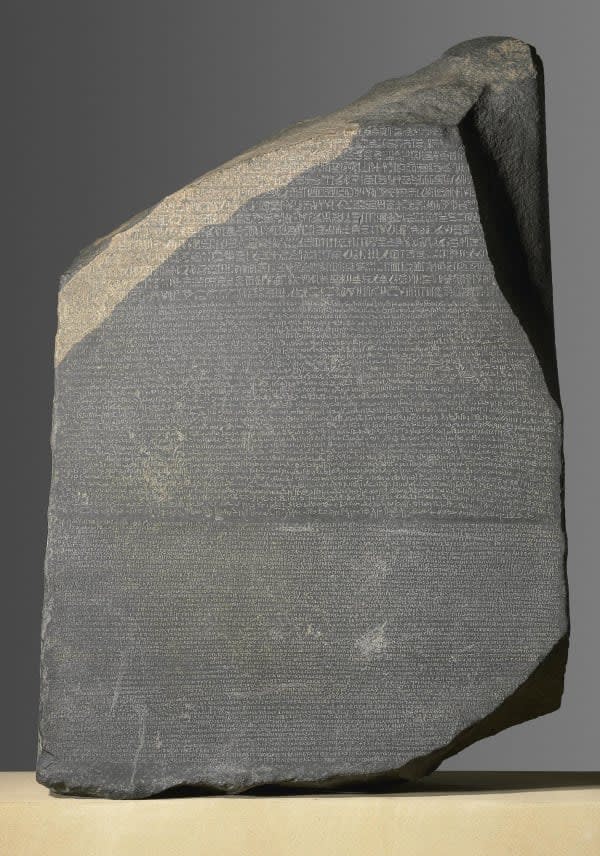
The Rosetta Stone © The Trustees of the British Museum
Rotten Romans
Ptolemy VI became Pharaoh as a six year old. Defeated by the Seleukids ten years later he needed the (humiliating) intervention of Rome to get them out of Egypt. Ptolemy VI died in 145 BCE with no heir.
Pterrible Ptolemies
The actions of his younger brother (and at one time co-ruler) Ptolemy VIII5, encapsulate the love-hate character of the ruling family’s intra-familial relationships.
First he married his brother’s widow and his own sister, in order to control this potential rival. Soon after having a son together “the king began a relationship with his niece, Cleopatra III. He wed her while he was still married to her mother, Cleopatra II – and elevated her to the rank of queen.” Again this outraged the Greek subjects. And again the Egyptians were more blasé - this was simply the divine royal family behaving the way gods have behaved since time began.
The mother and daughter Cleopatras became bitter rivals and eventually the rivalry erupted into civil war, with mum Cleopatra driving daughter Cleopatra and uncle Ptolemy out of Alexandria.
Ptolemy VIII then started to worry that his own son by mum Cleopatra might be a threat. To prevent any trouble it is reported that:
Ptolemy VIII then had his son’s body dismembered and the parts delivered to Cleopatra II [his sister, wife, brother's widow, plus his son's mother] in Alexandria, timed to arrive the night before her birthday celebrations.
Toby Wilkinson, The Last Dynasty
After this gruesome stunt and success on the battlefield, Ptolemy VIII and Cleopatra III (the niece) regained control and it was Cleopatra II’s (the mum) turn to flee. Ptolemy VIII herded his sister’s supporters into the gymnasium at Alexandria and burned them all to death.
His position now secure, he spent most of the rest of his reign building and renovating temples, before proving there is no justice in the world by dying peacefully of natural causes in 116 BCE.
Power politics
From this point on it was more of the same: more Ptolemies, more Cleopatras, more incest, and a whole lot more infighting. All the while the Romans were getting stronger and closer. Eventually, when it comes to the Cleopatra that we all know (Cleopatra VII) it required some highly dextrous statecraft to turn Julius Caesar and then Mark Antony into Egyptian allies rather than despoilers, a feat which was not possible when Octavian defeated Mark Antony and marched into Egypt with his army.
The Romans were not interested in becoming pharaohs, they just wanted the money (and grain). So with the end of the Ptolemies came the end of a line of Egyptian pharaohs that was at least 3,000 years old.
Ptwo dimensional
What makes The Last Dynasty so interesting is that it goes much deeper than my one dimensional political summary above.
For example we have:
-
🗺️ A survey of the Hellenistic world around Egypt with Macedonia in the north, the vast Seleukids empire to the east, and Nubia to the south. Then a day trip to see the sights of Alexandria.
-
🌾 The economic foundations of the kingdom including drainage and land reclamation in districts like Fayum to bring more land under cultivation.
-
🖼️ Portraits of some ‘ordinary people’: their lives and livelihoods, such as the scribe Menkhes and his work in rural Egypt.
-
🏛️ Egyptian temples and religious life, including the bizarre animal mummification craze whereby “as many as 10,000 [ibis] birds were reared, mummified and buried in the Memphite necropolis every year”.
-
⚱️ The often tense relationship between Greeks and Egyptians, and, as far as possible, the Egyptian outlook.
For me these descriptions of ordinary life were the most interesting bits of the book - how the Geeks disrupted but also coexisted alongside the Egyptians was something I have wondered about in the past.
Any downsides?
The book is pretty easy to read and wears its scholarship lightly. I only started to lose track of the Ptolemies after the 8th one (as you might have guessed from my summary above) which I think says a lot for Wilkinson’s power to engage.
The only negative to highlight is that it does feel at times like it has been bashed out at speed, without too much care for the prose. This is mainly an issue when Wilkinson is describing the various cities, which sound at times like he is writing for the Ptolemaic Tourist Board, or an ancient lonely planet guidebook.6
Conclusion
The Last Dynasty covers a lot and does it well. If you have even a passing curiosity in the Ptolemies, or the Rosetta Stone, or the Greeks in general, or even the Romans I would recommend this book.
If you are an Allan Partridge fan you might also like to know that this is the same as 26.9 million episodes of the Darling Buds of May, 13.5 million episodes of Doctor Who or 53.8 million episodes of Knowing Me, Knowing You with Alan Partridge. If you are more interested instead in how I counted Egyptian pharaohs you can see my google spreadsheet which counts Egyptian pharaohs (see sheet 2). The spreadsheet pulls data from this wikipedia list of pharaohs (which hopefully is the consensus view) and then lines all the pharaohs up in a single column. If I have got any of this wrong please update the wikipedia page directly and with a bit of luck it will all pull through. I’m 100% certain that I’m not the first person to count them in this way but I couldn’t find any other handy single “all the pharaohs” csv file! ↩︎
Again somewhat surprisingly, it is not that easy to find a decent source for this on the internet. But here is a nice one in German that sets out how many layers of stone there are in the Great Pyramid of Giza ↩︎
I found this hard to believe so I went to back to my favourite academic source: wikipedia, where a list of the dynasties of Egypt shows that this is indeed the case, with the Ptolemaic dynasty clocking in at 275 years (a conservative number), vs the runner up 18th dynasty at 258 years long. ↩︎
Although I have to admit that this is pure postulation. ↩︎
In case you are wondering why we went straight from Ptolemy VI to Ptolemy VIII, this is because the person who was previously thought by academics to be Ptolemy VII turned out not to exist, but by the time they realised this they had already named Ptolemy VIII and it was too late to turn back. ↩︎
I also got the feeling that Wilkinson “one shotted” the description of the sacred precinct of Ptah in Memphis (now Cairo): “There were also special areas... in one enclosure grew a special tree under which sat a sacred baboon.” What was special about the tree? How did they identify the sacred baboon? And how did they get it to sit still? ↩︎
Book details
(back to top)- Title -
The Last Dynasty : Ancient Egypt from Alexander the Great to Cleopatra
- Author -
Toby Wilkinson
- Publication date -
October 2024
- Publisher -
Bloomsbury Publishing
- Pages -
384
- ISBN 13 -
9781526664648
- Podcast episode -
Saturday Morning: The last great dynasty of ancient Egypt - Toby Wilkinson
- Amazon UK -
- Amazon US -